BCW2011 Credit Line Walkthrough#
Work through this page after BCW2011 Hedging Walkthrough.
The code discussed here is:
src/example/BCW2011CreditLine.py
What To Watch#
By the end of this page, you should understand:
why the state domain expands from
[0, \bar w]to[-c, \bar w],how BCW’s cash region and credit region are combined in one FinHJB solve,
how issuance and payout conditions coexist with a piecewise HJB,
why Figure 7 is the repository’s clearest example of regime-dependent residual logic.
Reproduction#
Run this example from the repository root:
MPLBACKEND=Agg uv run python src/example/BCW2011CreditLine.py
What Changes Relative To Refinancing#
The refinancing case assumes the firm issues equity when cash hits zero. The credit-line case inserts another financing layer in the pecking order:
internal cash,
credit line,
external equity.
This changes both the admissible state domain and the HJB.
Paper Equations Used In This Case#
Cash Region#
For w > 0, the firm is financing on internal cash, so the value function still satisfies BCW Eq. (13):
Credit Region: Eq. (31)#
For w < 0, the marginal source of financing is the credit line, so the carrying term changes:
The only structural difference is the financing term:
(r-\lambda)win the cash region,(r+\alpha)win the credit region.
That simple switch creates the paper’s different economics on the two sides of w=0.
Issuance Condition With A Credit Line#
Once the firm exhausts the line at w=-c, issuance satisfies:
So the credit line changes the location of the issuance trigger and the total equity raise amount, but not the smooth-pasting logic after issuance.
Continuity At w=0#
BCW states that the value function is continuous and smooth at w=0.
The repository implementation handles this numerically by solving one common value function on the entire domain [-c, \bar w] with one shared grid and one shared derivative operator:
the residual switches funding terms when
wchanges sign,but
v,dv, andd2vare still solved as one object on one grid.
So the stitching at w=0 is not implemented as an extra explicit boundary target. It is enforced numerically by solving a single global object across both regimes.
How The Piecewise Problem Becomes FinHJB Code#
Economic object |
FinHJB object |
Repository role |
|---|---|---|
credit-line parameters |
|
adds |
extended state domain |
|
sets |
investment control |
|
still only needs |
investment FOC |
|
unchanged Eq. (14) rule |
piecewise HJB |
|
switches financing term by region |
issuance boundary |
|
adjusts Eq. (19) for issuance at |
This is the key modeling pattern to notice:
the state grid crosses a regime boundary,
the value function stays global,
the residual changes by region.
Why The Solver Still Searches v_left And s_max#
Even though the state domain is larger, the outer unknowns are familiar:
the left boundary value at
w=-c,the right payout boundary
\bar w.
The issuance amount is again inferred from the derivative condition p'(m)=1+\gamma.
So the repository still uses a two-target boundary_search(method="hybr"), with the only modification being that the left issuance residual accounts for the extra draw c.
Figure 7: How To Read The Comparison#
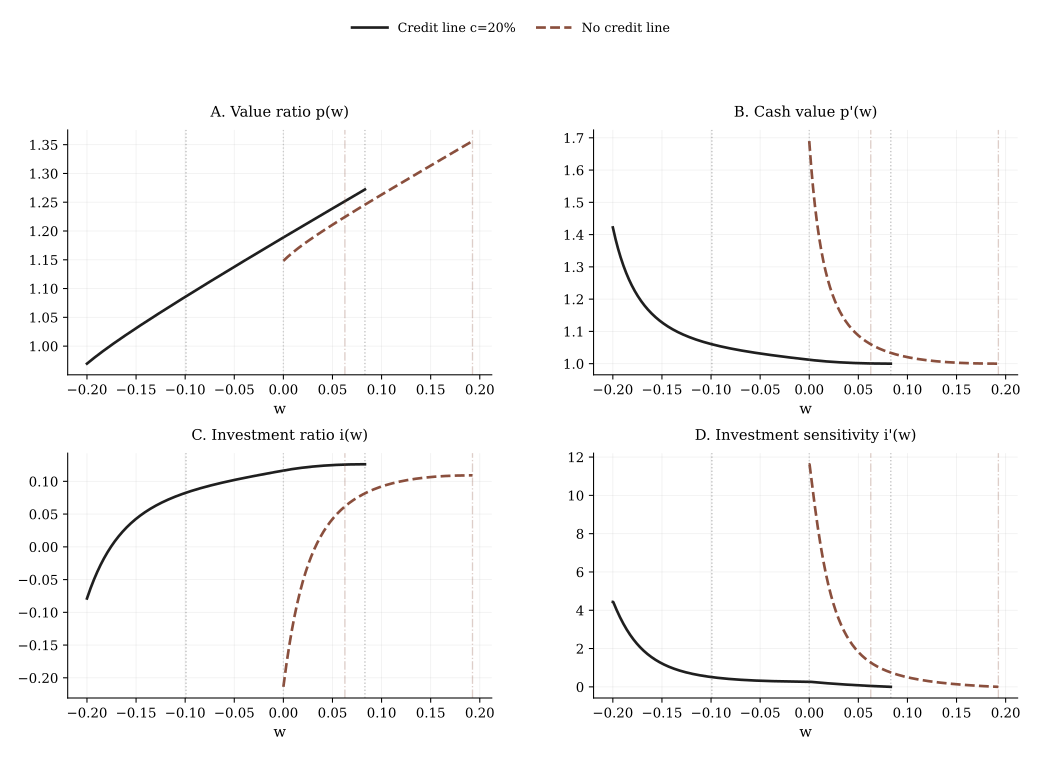
Panel A: p(w)#
Access to the credit line raises value and moves the payout boundary left. The firm needs to hoard less precautionary cash.
Panel B: p'(w)#
The marginal value of cash near w=0 collapses relative to the no-credit benchmark because hitting zero cash no longer means immediate issuance.
Panel C: i(w)#
Underinvestment is sharply mitigated. With a credit line, investment at w=0 remains positive instead of turning into large asset sales.
Panel D: i'(w)#
The investment-cash sensitivity is flatter near the cash boundary because the financing regime changes more smoothly than in the no-credit benchmark.
Stable Quantitative Targets#
Healthy runs usually show:
with
c=20%:\bar w \approx 0.08,with
c=20%:c+m \approx 0.10,with
c=20%:p'(0) \approx 1.01,without a credit line:
\bar w \approx 0.19,p'(0) \approx 1.69,with a credit line:
i(0) > 0,without a credit line:
i(0) < 0.
These are the right checks against BCW Figure 7.
Code Inspection Pattern#
from src.example.BCW2011CreditLine import run_case

bundle = run_case(number=1000)
for label, result in bundle["results"].items():
    print(label, result["summary"])
The summary fields to inspect first are:
credit_limit,equity_raise_amount,dv_at_zero,investment_at_zero,state_min.
How To Adapt This Pattern#
Start from this case if your own model has:
a single state variable but multiple financing regimes,
a negative-state debt region,
a piecewise HJB residual on a shared grid,
issuance after another financing source is exhausted.
This is the cleanest repository template for regime-dependent one-dimensional finance models.